
Door open: Slowing economy paves the way for a pause in rate hikes
Weaker than expected economic growth in the first three months of the year is likely to see Aussies spared from a fourth consecutive rate hike in two weeks time.

Inflation concerns peaking
Headline inflation slowed from a near three-year high in April, with both the effects of the global energy shock and the government’s cost-of-living relief measures flowing through to the economy.
The Consumer Price Index rose 4.2% for the 12 months to April, coming largely off the back of the halved fuel excise, which is set to be reverted next month.
While headline inflation is significant higher than the Reserve Bank’s 2-3% target range, underlying inflation is lower at 3.4%.

Monetary policy board member Ian Harper said the RBA was ready to take serious action to bring inflation down if needed, warning success is dependent on public sentiment and spending.
“The ability to lower the rate of inflation and get back on track is heavily dependent on its persistence and what people think is going to happen to inflation and the state of the underlying economy,” he explained.
“Persistence more likely when supply shocks add to existing capacity.”
Looking forward, Mr Harper said the bank expects the economy to continue to slow.
“As the economy slows, there will also be a slowing of the labour market,” he said. “The labour market was judged to be a little tight before this, so what this means is reducing the labour pressures back and restoring more balance.”
Underlying inflation, which strips out the most volatile price changes to provide a more accurate picture, is expected to be back in the RBA’s 2-3% target range late 2027, estimates show. The bank is not expecting it to hit the middle point of the target until mid-2028.
With high inflation rampant, Mr Smith warned the latest look at the economy’s growth was “uncomfortable” for policymakers.
"The economy is cooling, but not in a way that suggests inflation will fall neatly back to target,” he warned.
“Productivity weakened again and unit labour costs remain elevated, meaning the Reserve Bank will see softer activity, but not necessarily evidence of easing domestic cost pressures.”
Housing market struggles
Australia’s housing market is facing one of the most turbulent market environments in recent times as inflation continues to remain hot.
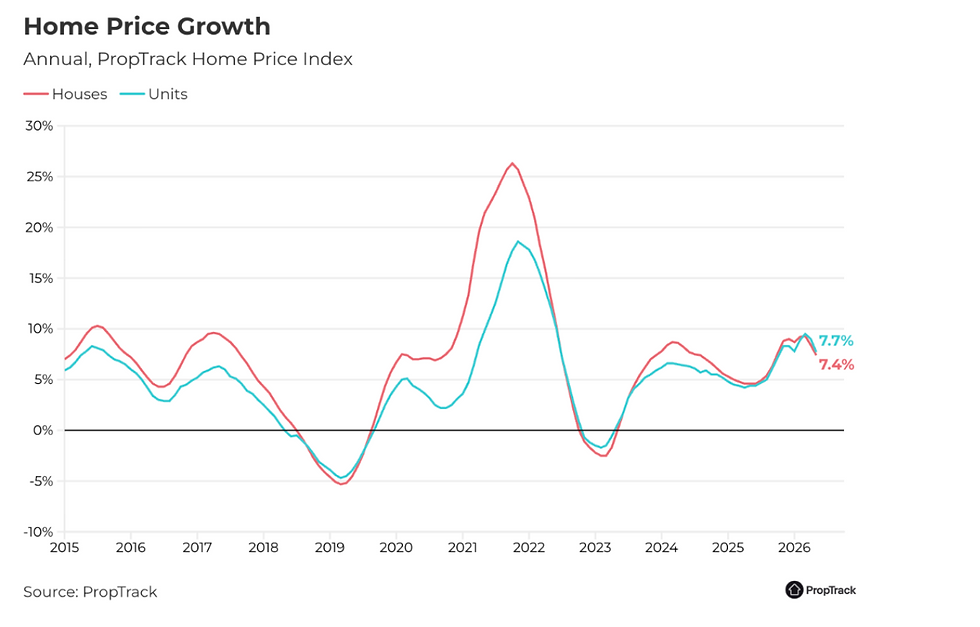
Median home values fell in both April and May after almost two years of solid growth.
The latest PropTrack Home Price Index shows home prices decreased 0.04% nationally last month, with prices noticeably down in capital cities where homes are more expensive.
It comes as the Reserve Bank’s latest monetary policy board meeting minutes from 5 May warned the war in the Middle East is harming the housing market, which has seen the “most immediate effect” of its policy tightening.
Caution is also widely expected among buyers and sellers heading into the traditionally quieter winter period, after changes to negative gearing and the capital gains tax in this month’s federal budget moved the dial significantly on how Aussies can benefit from real estate investment.
Speaking after the RBA’s rate hike earlier this month, governor Michele Bullock said Australians should gear up for “a very tough time” when it comes to household finances, acknowledging concerns of mortgage repayment affordability and house prices. Mr Harper used his address this week to reiterate the board’s view that housing issues “are important for all Australians” despite what it has argued is a limited ability to influence high home prices.
“It’s also true that monetary policy has an impact on the housing market,” he explained.
“Obviously on the rates of interest that people pay on their mortgages and indirectly via that on the housing markets themselves and the prices of houses.
“The bank is not targeting house prices. The bank’s task is to produce low and stable inflation which is the best thing it can do.” Mr Harper urged borrowers and homeowners to consider how “many other things influence the housing market” beyond the RBA, pointing instead to the government’s changes to property tax.
“All of these things will feed into decisions that people make about very important decisions on whether to buy a house or not or whether to stop renting or buy,” he said.
Interest rates on pause?
Westpac had previously forecast hikes in both June and August but softened its expectations after data earlier this month revealed unemployment is rising.
The Australian Stock Exchange rate tracker shows a 100% market expectation for a rate hold as of 1 June, though there are widespread expectations more tightening could come later this year.
“A fourth rate hike in 2026 is still on the table,” Mr Smith warned. “Australia is still growing, but the quality of growth has deteriorated.
“The outlook now depends on whether investment broadens beyond a handful of large projects, households regain real spending power, and external geopolitical headwinds begin to ease.”
Hope Coumbe, Finance Editor
First published 03 June 2026,


Comments